
How to Ask for Referrals: The 3-Minute Meeting Playbook That Gets Introductions
6 November 2026
How to Ask for Referrals: The 3-Minute Meeting Playbook That Gets Introductions

Use a simple three-minute format to make a specific referral request, listen for connections and follow up with context.
If you leave a referral meeting with good conversations but no clear next steps, the problem may be the ask. In this ThinkTank playbook, Ivan Kaye shares a simple way to use two or three minutes to explain who you want to meet and why, so your group can listen with intent and make relevant introductions.
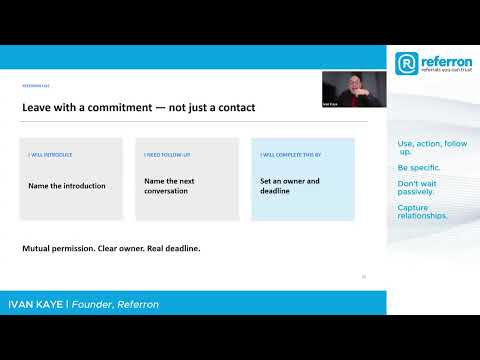
Watch: Ivan Kaye walks through the three-minute ThinkTank referral playbook.
Why a specific ask matters
Referral networking works best when people can recognise the person or situation you’re describing. If you ask for “anyone who needs my services”, group members have little to go on. A vague ask is harder to match to someone they know.
The ThinkTank format replaces a broad request with four useful details: an insight, the outcome you want, the capability you need and the exact referral you’re seeking. That gives the group a clearer picture of how to help.
The three-minute ThinkTank playbook
Each person gets two or three minutes. Use that time to share these four things:
- One insight. Share one insight from the knowledge share.
- Your desired outcome. Say what result you’re working towards.
- The capability you need. Describe the capability that would help you reach that outcome.
- Your exact referral request. Name the person you want to meet, and explain why.
The last point is key. Don’t stop at “I’m looking for new clients”. Describe who you want to meet and why that connection is relevant. The more clearly you explain the request, the easier it is for other members to recognise someone who may fit.

Listen with intent, not just your turn in mind
The playbook is not only about making your own ask. While others are speaking, listen for the outcomes and capabilities they mention, and think about people in your own network who may be relevant.
Ivan’s suggested next step is to add the person to the group Rolodex. A Rolodex is a record of people and their contact details. In the ThinkTank group, members can go to someone’s profile and add them as a connection; that person is then added to their connections too.
If someone in your network might be a fit for a member’s request, send your digital business card so the relationship is captured in your Rolodex. A digital business card is an online version of your contact details that you can share electronically.

Make permission-based introductions with context
A warm introduction is a connection made through someone both people know, rather than an unexpected cold message. Before connecting two people, ask for permission. Ivan describes mutual permission as a way to protect trust.
Then include a meaningful note. Briefly explain who each person is and why you think they should speak. Context helps both people understand why the introduction is relevant, rather than receiving a connection request without a reason.
Think of the introduction as a handover, not just a name swap. A little care in the note makes the reason for connecting clear and gives the conversation a useful starting point.

Follow up on every connection
The ThinkTank video closes the loop with a simple instruction: follow up every introduction and connection made or received. The video doesn’t prescribe an exact number of hours or days, so a practical approach is to follow up once the connection is made, while the reason for it is still clear.
Your follow-up can thank the person who connected you, restate the context of the introduction, and confirm what happens next. If you received an introduction, acknowledge it and respond to the other person directly. If you made one, check that both people have what they need to continue the conversation.
Without that follow-through, a captured connection can remain just a name in a group Rolodex. Referral networking is about useful action as well as conversation, so make the follow-up part of the process.
How Referron supports the playbook
Referron helps you keep the steps of a referral meeting connected:
- Connections and the group Rolodex: Keep track of people you connect with through your group and wider network.
- Customised message templates: Prepare a message with the details needed to make a relevant introduction.
- Three-way referrals: Connect two people with context, rather than passing along contact details without an explanation.
- Digital business card sharing: Share your details by QR code, NFC or WhatsApp. A QR code is a scannable square that opens a link; NFC (near-field communication) lets compatible devices share information when brought close together.
- Activity tracking: See referral activity in real time, helping you keep follow-ups from slipping. Referral tracking software is a tool for recording introductions and related activity.
You can also explore Referron’s resources and guides for more on sharing cards, managing connections and making three-way referrals.

Copy this checklist for your next meeting
Use these prompts to prepare your own two- or three-minute turn:
One insight:
The outcome I want:
The capability I need:
My exact referral request: I’d like to meet [who] because [why].
While others speak, listen for relevant connections and add people to your group Rolodex. Before making an introduction, get permission from both people and include a note explaining why they should speak. Then follow up on every connection made or received.
Key takeaways
- Make a specific ask: who do you want to meet, and why?
- Use your meeting time to share one insight, your desired outcome, the capability you need and your exact request.
- Listen for relevant connections while others speak.
- Ask permission before introducing two people, and include meaningful context.
- Follow up on every introduction and connection.
FAQs
What is a permission-based referral?
It’s an introduction made with the agreement of the people being connected. Ask before making the connection, then include context so both people understand why you’ve introduced them.
How do I ask for referrals without sounding desperate?
Be clear about the person you want to meet and why the connection is relevant. A specific request gives others a genuine way to help, without putting pressure on them to produce a referral.
What should an exact referral request look like?
Say who you want to meet and why. For example, use the template: “I’d like to meet [who] because [why].”
What should I do after a referral meeting?
Follow up on each introduction and connection made or received. Thank the people involved, remind them of the context and confirm the next step.
When you’re ready to share your details, create a free Referron card, or download the app and set it up from your phone:
